

What to Know About the Russia Tsunami and Waves Impacting the Pacific Coast. Massive 8.8-Magnitude Earthquake Triggers Tsunami Across Pacific
On July 30, 2025, an 8.8-magnitude earthquake struck off Russia’s Kamchatka Peninsula, centered 75 miles (119 km) east-southeast of Petropavlovsk-Kamchatsky, a city of 165,000. This megathrust quake, among the strongest ever recorded, unleashed tsunami waves that impacted Russia, Japan, Hawaii, California, and other Pacific regions, prompting widespread evacuations and alerts. Below is a detailed overview of the earthquake, its tsunami effects, and broader implications, using the provided information and web sources for context, while critically examining the narrative for accuracy.
A Historic Earthquake Rocks Kamchatka
The earthquake hit at 11:24 a.m. local time (7:24 p.m. ET, July 29, 2025) in the Kuril-Kamchatka subduction zone, where the Pacific Plate subducts beneath the North American Plate. The U.S. Geological Survey (USGS) reported a shallow depth of 12.9 miles (20.7 km), intensifying its impact. Tied with the 1906 Ecuador and 2010 Chile quakes as the sixth-largest ever recorded, it surpassed recent seismic events but was less severe than the 1952 Kamchatka 9.0 quake.
In Petropavlovsk-Kamchatsky, residents endured over three minutes of violent shaking, with cars swaying, cabinets toppling, and balconies trembling. Russia’s Tass news agency reported power outages and mobile service failures, with people fleeing homes in slippers or bathrobes. A kindergarten’s facade collapsed, and injuries included one person jumping from a window and another hurt at the airport terminal, though Kremlin spokesman Dmitry Peskov claimed no fatalities, citing robust construction and effective alerts.
The quake triggered the eruption of Klyuchevskoy volcano, Eurasia’s highest, 450 km north of Petropavlovsk-Kamchatsky. Lava flows and ash plumes were reported, with no direct casualties linked to the eruption. Russian authorities declared a state of emergency in Petropavlovsk-Kamchatsky and Severo-Kurilsk, evacuating 3,000 people. Aftershocks, including a 6.9-magnitude event, continued, with experts warning of potential 7.5-magnitude tremors for weeks.
Tsunami Waves Sweep Across the Pacific
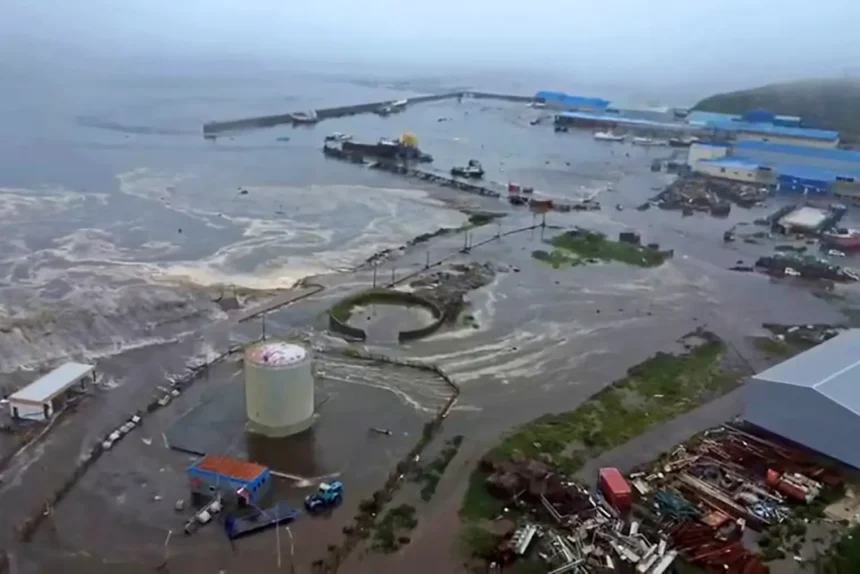
The shallow quake generated tsunami waves that radiated across the Pacific. In Russia’s Severo-Kurilsk, a port town of 2,000 in the Kuril Islands, waves of 3–5 meters flooded the seaport, damaging a fish processing plant and sweeping away fishing boats. Residents were evacuated to higher ground, and tsunami warnings were lifted by Wednesday evening.
In Japan, nearly 2 million people across 220 municipalities from Hokkaido to Okinawa were urged to evacuate. The Japan Meteorological Agency (JMA) initially warned of 3-meter waves, with a 1.3-meter wave hitting Kuji port in Iwate Prefecture at 1:03 p.m. local time and another in Hamanaka at 1:11 p.m. No major damage or injuries were reported, and warnings were downgraded to advisories, though caution remained due to potential later waves. The 2011 Tohoku quake (9.0 magnitude) loomed large, but this event caused minimal disruption.
Hawaii faced tsunami warnings from 7:17 p.m. local time (1:17 a.m. ET, July 30), with waves up to 5.7 feet above tide level in Kahului, Maui, and a 6-foot peak-to-trough wave at Midway Atoll. Governor Josh Green noted minor flooding on the Big Island but no widespread damage. Evacuations caused traffic jams in Honolulu, but warnings were downgraded to advisories by 11 p.m., with residents urged to stay vigilant.
California’s Arena Cove saw waves of 1.6 feet above tide level, while Crescent City reported rapid water level swings of over 3 feet, damaging a harbor deck. Tsunami advisories covered the West Coast from California to Alaska, with Washington’s La Push and Westport noting minor waves. Advisories were lifted by Wednesday evening with no major damage reported.

Other Pacific regions, like French Polynesia’s Marquesas Islands, saw waves of 1.1–2.5 meters, lower than the feared 4 meters. Chile and Ecuador evacuated coastal areas, including Easter Island and the Galápagos, but reported minimal impact. Alerts were issued for Guam, Fiji, Samoa, and others, but most were downgraded as waves were smaller than expected.
One Reported Fatality
While Russian authorities reported no deaths, Japan’s Asahi Shimbun noted a 58-year-old woman died after her car veered off a cliff while fleeing to higher ground in Japan. This remains the only confirmed tsunami-related fatality, highlighting the effectiveness of evacuation protocols despite the quake’s magnitude.
Why It Matters: Seismic and Tsunami Risks
Kamchatka lies on the Pacific Ring of Fire, a seismically active region prone to megathrust quakes. Experts like Nathan Bangs compared this event to the 2004 Sumatra and 2011 Tohoku quakes, which caused devastating tsunamis. The shallow depth amplified the tsunami risk, but low population density in Kamchatka and swift alerts minimized casualties. Robert Weiss warned of potential damage from 3–5-meter waves, though impacts were less severe than feared.
The event underscores Pacific vulnerabilities. The 1952 Kamchatka quake caused 30-foot waves in Hawaii, showing the region’s history of far-reaching tsunamis. Modern warning systems, like the PTWC and JMA, proved effective, but aftershocks and locked fault energy could trigger further events.
Critical Perspective
Russian claims of no fatalities seem optimistic given reported damage, like the kindergarten collapse and port flooding. The single Japanese fatality highlights evacuation risks, such as panic-driven accidents, which deserve scrutiny. The Klyuchevskoy eruption, while not directly tied to casualties, raises concerns about compounded risks in volcanic regions, potentially understated by official reports.
Moving Forward
As of July 30, 2025, most tsunami warnings are lifted, but advisories persist in parts of California and Alaska due to aftershock risks. Pacific nations remain vigilant, with Chile and Ecuador monitoring coastal areas. The event emphasizes the need for robust seismic infrastructure and real-time alert systems in geologically active regions like Kamchatka.